AI Agents Are Coming for the Back Office — and Your AI Tools Are Getting Cheaper
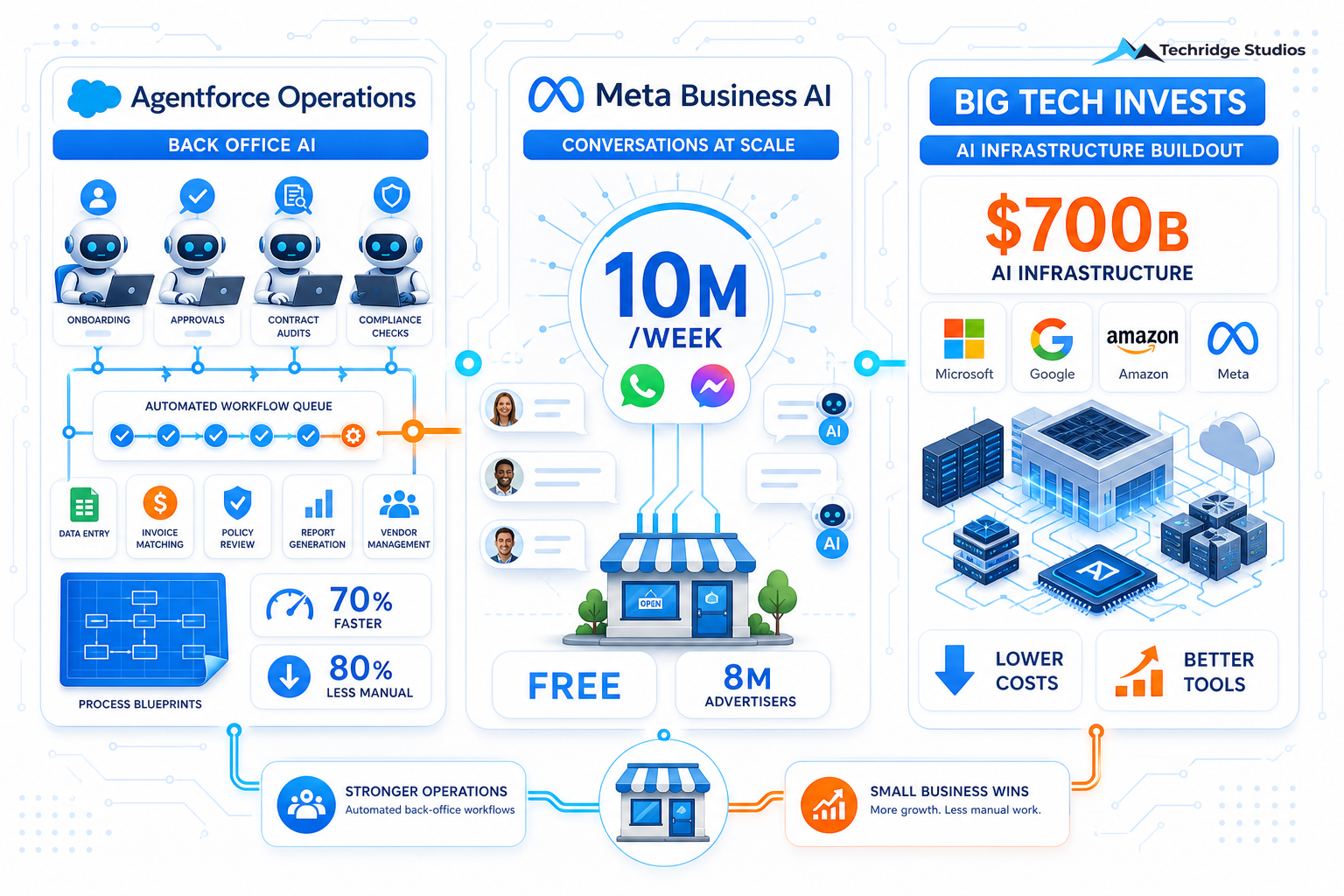
This weekend's AI brief covers three developments with direct impact on small businesses: Salesforce pushing AI agents into back-office workflows, Meta's free business AI scaling faster than anyone expected, and the infrastructure arms race that keeps your AI tools affordable.
Salesforce Launches Agentforce Operations — The Back Office Gets Its Own AI Crew
For years, AI in business meant front-office automation: chatbots, sales prompts, marketing copy generators. The back office — onboarding, approvals, data verification, compliance reviews — stayed manual. Salesforce changed that on April 29, 2026, with the general availability of Agentforce Operations.
Agentforce Operations deploys specialized AI agents into the workflows that typically create the most bottlenecks in a small business. Instead of a human chasing approvals across email threads or manually entering data between two systems, agents handle the coordination and execution. Users can start with one of more than 30 pre-built workflow blueprints covering common processes like employee onboarding, contract audits, and compliance clearance. No custom coding is required.
The performance claims are significant. Salesforce reports that organizations using Agentforce Operations see cycle times drop by 50 to 70 percent and manual task volume fall by up to 80 percent. Ecosystem integration features — including the ability to auto-sync data with Salesforce Flows — are entering beta this month, which will make the platform more useful for small businesses already running their operations inside Salesforce.
For a small business owner who has been automating customer-facing tasks for the past year, Agentforce Operations represents a natural next step: applying the same AI agent approach to the administrative infrastructure underneath the business.
Meta Business AI Hits 10 Million Conversations a Week — Still Free
Meta disclosed during its Q1 2026 earnings call on April 30 that its free business AI tools are now facilitating 10 million conversations per week through WhatsApp and Messenger. At the start of 2026, that number was 1 million. The 10 times growth happened in a single quarter.
The tools allow small businesses to deploy an AI that handles customer inquiries, responds to messages, and manages simple service workflows — entirely within the messaging apps their customers already use. WhatsApp has expanded to Latin America and Indonesia; Messenger is live across the Asia Pacific region, with global expansion underway in Q2.
Over 8 million advertisers are now using at least one of Meta's generative AI ad creative tools, with particularly strong adoption among small and medium-size businesses. The ad tools can generate copy, images, and ad variants — reducing the time and cost of producing test campaigns.
Meta CEO Mark Zuckerberg confirmed on the earnings call that a longer-term monetization model is in development. The business AI tools are currently free. For small businesses, the window to build with these tools before pricing arrives is open now. Getting your business AI set up on WhatsApp or Messenger today — building workflows, training it on your products and policies — puts you ahead of most competitors who have not yet touched this.
Big Tech's 700 Billion Dollar AI Infrastructure Bet — Why It's Good News for Small Businesses
Fortune reported on April 30, 2026 that Microsoft, Google, Amazon, and Meta are collectively on track to spend 700 billion dollars on AI infrastructure in 2026. That figure is more than double the buildout pace of two years ago, and by most analyst projections, it has no clear ceiling in sight.
For small businesses, this number matters — not because they are writing the checks, but because they benefit from the competition. The four hyperscalers are racing to capture AI demand, which means they are competing on price, capability, and availability. Every time Amazon Web Services, Google Cloud, and Microsoft Azure bid against each other for AI workloads, the cost of processing those workloads falls.
This is the mechanism behind the pattern small businesses have already noticed: AI tools that cost hundreds of dollars per month two years ago are now available at a fraction of that cost, or free at introductory tiers. The tools themselves are more capable — longer context windows, better reasoning, faster responses. The 700 billion dollar investment is the engine driving that improvement cycle.
The practical implication is straightforward: the AI tools available to you now will be more powerful and less expensive by the end of 2026. Building competency with the tools that exist today positions you to extract more value from what comes next.
What This Means for Your Business
This weekend's brief has one clear throughline: AI is moving from customer-facing to operations-wide, and the underlying infrastructure is maturing fast enough to support it.
Agentforce Operations tells you that the back-office bottlenecks most small businesses accept as unavoidable — approval delays, manual data work, compliance drag — have a viable automation path today. Meta's numbers tell you that AI on messaging platforms is real, scalable, and currently free. The infrastructure numbers tell you that the direction of travel is toward more capable, lower-cost tools.
The single next action worth taking this week: pick one back-office task that involves human coordination steps — onboarding a client, getting an internal approval, routing data between two systems — and map out what it would look like if an AI agent handled it. That mapping exercise is the first step toward making it happen.
Sources
SiliconAngle — https://siliconangle.com/2026/04/29/salesforce-introduces-agentforce-operations-automate-outdated-back-office-tasks/
TechCrunch — https://techcrunch.com/2026/04/30/meta-says-its-business-ai-now-facilitates-10-million-conversations-a-week/