OpenAI Leaves the Azure-Only Club — And Your Business Benefits
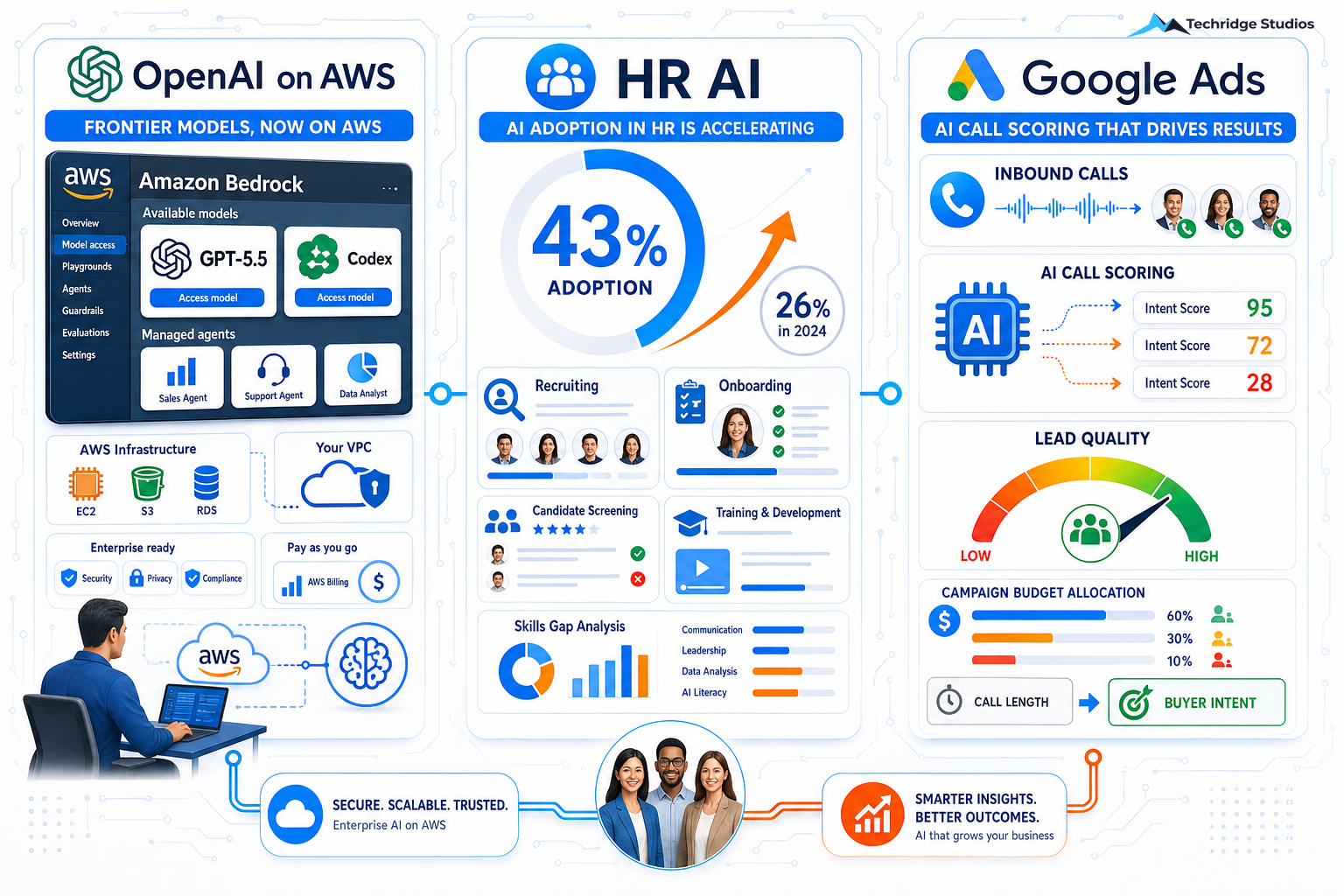
Three stories this week point to the same underlying shift: AI is becoming infrastructure, not a special feature. OpenAI is now available through Amazon's cloud with no Microsoft contract required. HR teams are using AI for hiring at nearly double the rate from two years ago. And Google is using AI to help you stop wasting budget on dead-end phone leads. Here is what each one means for your business.
OpenAI Models Are Now Available on Amazon Web Services
For the past several years, accessing OpenAI's flagship models required either a direct subscription to ChatGPT or a relationship with Microsoft Azure. That changed on April 28 when OpenAI and Amazon announced that GPT-5.5, Codex, and Bedrock Managed Agents are now available in limited preview through Amazon Web Services Bedrock.
The context matters. Microsoft and OpenAI recently amended their partnership, ending Microsoft's exclusive license on OpenAI's models. That structural change opened the door for OpenAI to bring its technology to other cloud platforms — starting with Amazon, the largest cloud provider in the world. It is a significant shift in how AI tools get distributed and procured.
If your business already operates on AWS — and many do, given Amazon's dominant cloud market share — you can now request access to OpenAI's frontier models through the same console you use for your existing infrastructure. Usage counts toward your existing AWS spending commitments, which can simplify billing and potentially reduce effective costs if you carry cloud credits or have an annual commit in place.
The practical takeaway is direct: you now have more options and more leverage. If you have been building on AWS and assumed OpenAI required a Microsoft account, that assumption no longer holds. Log into your AWS console, navigate to Amazon Bedrock, and request access to the OpenAI model preview. Evaluate whether GPT-5.5 or Codex fits a workflow you are already running before committing to a new contract with anyone.
HR AI Adoption Is Up 65 Percent in Two Years — Are You Keeping Pace?
The Society for Human Resource Management published its State of AI in HR 2026 report this week, drawing on responses from 1,908 HR professionals across industries. The headline number: 43 percent of organizations are now using AI across HR tasks, up from 26 percent in 2024. That is a 65 percent increase in two years, and the pace shows no signs of slowing.
The leading use cases are recruiting (27 percent of respondents), HR technology configuration (21 percent), and learning and development (17 percent). In plain terms, organizations surveyed are using AI to screen candidates, configure HR systems, and build training materials. None of those are exotic use cases — they are the kind of work that consumes dozens of hours per month in a small business where the owner is also the HR department.
For founders and operators who handle HR without a dedicated team, this data is a calibration point. Your competitors who are a step ahead on AI are using it to write smarter job descriptions, screen candidates faster, and deliver onboarding in a fraction of the time it would take manually. The gap between early adopters and late movers does not stay static — it widens every quarter as the tools improve and adoption normalizes.
If you are still drafting job postings from scratch and reviewing every resume manually, the starting point is accessible and low-cost. ChatGPT Business handles job description drafting. Tools like Greenhouse, Workday, and Findem have AI screening built in at accessible price points. Start with one workflow — job description writing or first-pass candidate screening — and measure the time you get back. Build from there.
Google Ads Is Using AI to Tell You Which Calls Actually Matter
For businesses that use Google Ads to generate inbound phone calls, call duration has long been the default quality signal. A caller who stays on the phone for two or more minutes is more likely to be a real prospect than someone who hangs up in 30 seconds. That logic made sense as a rough filter — until this week.
Google Ads launched AI-qualified call conversions, replacing duration as the primary metric for evaluating phone leads. The feature analyzes actual call recordings using AI, listening for signals of genuine purchase intent rather than just timing the call. A three-minute call from someone who called the wrong number counts differently than a 90-second call from a buyer who confirmed an appointment and asked about pricing. The AI scores the conversation, not the clock.
For small businesses running any kind of lead generation through Google Ads — service businesses, home improvement contractors, professional services, healthcare practices, retail — this directly changes how you measure what is working. If you have been optimizing campaigns for calls that meet a duration threshold, you may have been inadvertently rewarding campaigns that generate confused or misdirected callers rather than interested buyers. AI-qualified call scoring surfaces which campaigns are actually producing real purchase intent.
Enabling this in your Google Ads account is worth doing now, even starting in tracking-only mode. Navigate to Conversions in your account settings and look for the AI-qualified call options. Run the new scoring alongside your existing duration-based tracking for a few weeks before making any budget shifts based on the new data. The comparison will tell you more about your current campaigns than any other audit you could run.
What This Means for Your Business
AI is getting more accessible, more embedded in everyday tools, and more precise — all at the same time. OpenAI on AWS removes a procurement barrier that was keeping businesses locked into a single cloud relationship. HR AI at 43 percent sets a new competitive baseline for what efficient hiring looks like. Google Ads call scoring raises the accuracy of how you measure your paid lead generation.
The single next action: pick one of these three and move on it this week. If you run Google Ads with call extensions, enable AI-qualified call tracking today. If you are hiring in the next 90 days, test one AI-assisted screening tool before you open your next position. If your business runs on AWS, request the Bedrock preview access for GPT-5.5 and run a test prompt against a workflow you use every day. Small, deliberate moves compound faster than you expect.
Sources
OpenAI Blog — https://openai.com/index/openai-on-aws/
SHRM State of AI in HR 2026 — https://www.shrm.org/topics-tools/research/state-of-ai-hr-2026
MarketingProfs AI Update, May 1, 2026 — https://www.marketingprofs.com/opinions/2026/54640/ai-update-may-1-2026-ai-news-and-views-from-the-past-week