AI Is Writing the Code, Cutting the Price, and Changing How Customers Find You
Three stories today share a common thread: AI is no longer a tool you use on the side. It is becoming the way work gets done, the way products get built, and the way customers discover your business. If you run a small business, each of these developments has a direct implication for how you operate this year.
Airbnb Says AI Now Writes 60 Percent of Its Code
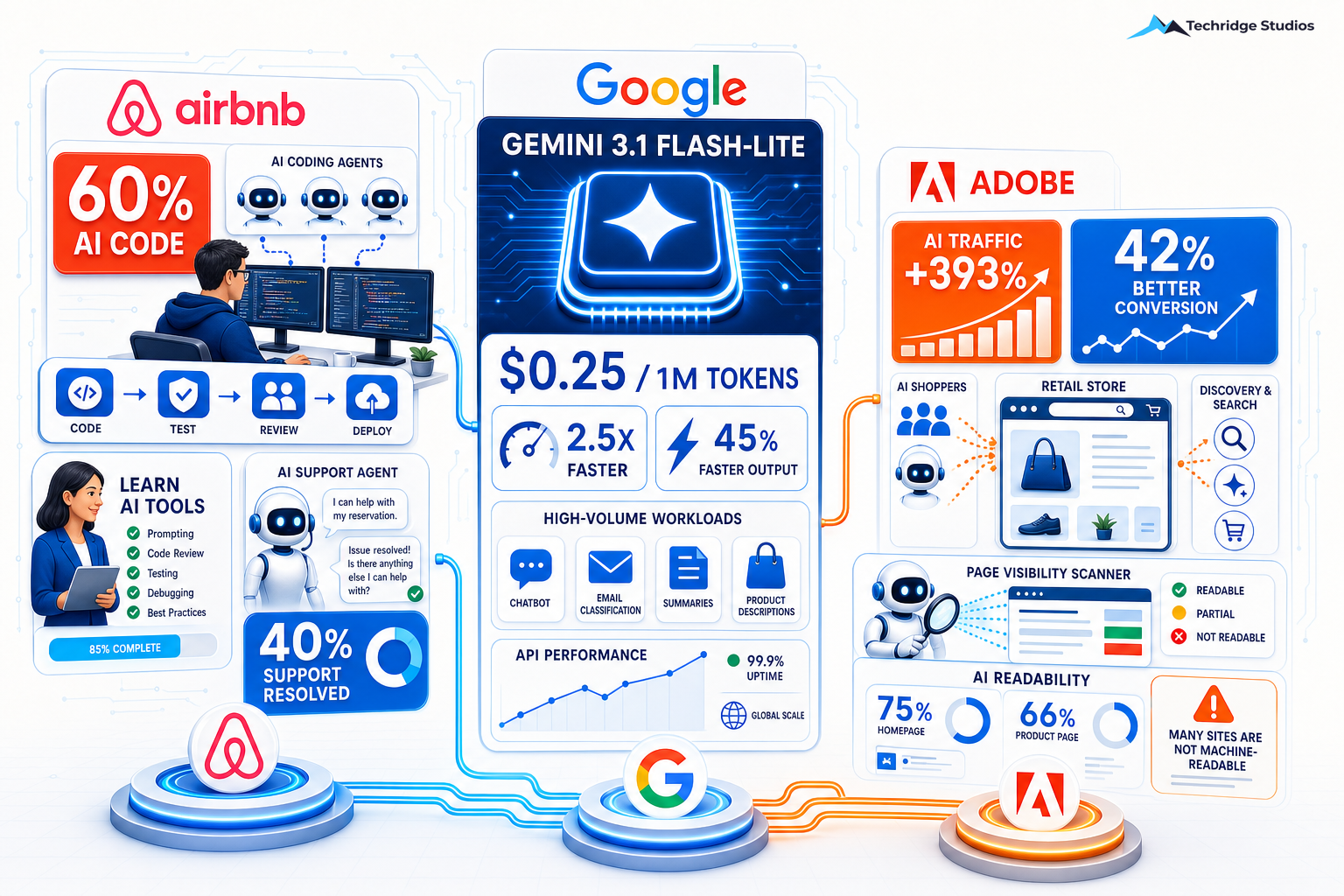
During its first quarter 2026 earnings call on May 8, Airbnb CEO Brian Chesky made a statement that should get every business owner's attention. AI now writes 60 percent of the company's new code. That puts Airbnb ahead of Google, which reports around 30 percent, and in line with Shopify at roughly 50 percent.
But the bigger story is what Chesky said next. He told his entire management team that there is no longer room for "pure people managers." Every manager at Airbnb is expected to either learn to code or use AI coding tools like Claude Code. The company is not cutting engineers. It is multiplying their output. Where a project once required a dedicated team of 20, a single engineer can now deploy AI agents to handle significant portions of the work.
For small businesses, the signal is clear. AI coding assistants are not just for software companies. If you build websites, automate workflows, or manage any technical process, one person with the right AI tools can produce what used to require a full team. The cost of building just dropped.
Airbnb also disclosed that its AI-powered customer support bot now resolves 40 percent of all support issues without any human involvement, up from roughly 33 percent earlier in the year. That is a direct labor savings that scales.
Google Launches the Cheapest Tier-One AI Model on the Market
On May 7, Google Cloud announced that Gemini 3.1 Flash-Lite is now generally available. Priced at 25 cents per million input tokens and $1.50 per million output tokens, it is the most affordable model from any major AI provider in 2026.
The model is not just cheap. It delivers 2.5 times faster response times and 45 percent faster output generation compared to earlier Gemini versions, while maintaining the same or better quality. It was built specifically for high-volume developer workloads at scale — the kind of repetitive, structured AI tasks that small businesses use most: summarizing documents, classifying support tickets, generating product descriptions, and powering chatbots.
For small business owners who have been watching AI pricing from the sidelines, this is the inflection point. Building AI into your app, website, or internal tools no longer requires an enterprise budget. At this price tier, the model cost for processing 1,000 customer emails or generating 100 product descriptions is virtually zero.
If you have been waiting for AI costs to drop before experimenting, the wait is over. Start with one workflow — customer support, content generation, or data processing — and test it at this price point.
AI-Driven Traffic to Retail Sites Is Up 393 Percent — But Most Sites Are Not Ready
Adobe Digital Insights released data showing that AI-driven traffic to U.S. retail sites grew 393 percent year over year in the first quarter of 2026. In March alone, AI traffic converted 42 percent better than traditional traffic from channels like paid search and email marketing. That is a complete reversal from March 2025, when AI traffic actually converted 38 percent worse.
The numbers tell a simple story: AI assistants are now sending real buyers to real websites, and those buyers are spending more. AI-driven revenue per visit was 37 percent higher than non-AI traffic. Shoppers arriving via AI spent 48 percent longer on site and browsed 13 percent more pages.
But here is the problem. Most retail and small-business websites are not readable by the AI tools that send that traffic. Adobe released an AI Content Visibility Checker — a free Chrome extension that scores any webpage on how well AI models can read it. The results are sobering. Homepages averaged 75 percent visibility. Product pages averaged just 66 percent. The lowest-scoring retailers had homepage visibility of around 54 percent.
If your website scores poorly, AI assistants cannot accurately describe your products or recommend your business. You become invisible to the fastest-growing traffic channel in retail.
The fix is actionable today. Install Adobe's free AI Content Visibility Checker from the Chrome Web Store. Run it on your homepage and your top product or service pages. Look for content that is locked in images, JavaScript, or dynamic elements that AI models cannot parse. Prioritize making your key selling points available as clean, machine-readable text.
What This Means for Your Business
The pattern across all three stories is the same: AI is shifting from an optional experiment to a required infrastructure. Airbnb is restructuring management around it. Google is pricing it for mass adoption. Adobe is measuring a new traffic channel that rewards businesses built for AI readability.
Pick one action from today's brief and do it this week. Test an AI coding tool on a project you have been putting off. Run the Adobe visibility checker on your website. Or explore what you can build at 25 cents per million tokens. The businesses that move now will compound their advantage over the ones still watching.
Sources
Sources — AI in 60 | May 9, 2026
TechCrunch — https://techcrunch.com/2026/05/08/airbnb-says-ai-now-writes-60-of-its-new-code/
Google Cloud Blog — https://cloud.google.com/blog/products/ai-machine-learning/gemini-3-1-flash-lite-is-now-generally-available
Adobe Business Blog — https://business.adobe.com/blog/ai-traffic-surge-retail-sites-not-machine-readable