AI Will Reshape Your Workforce, Your Competition, and Your Security — All at Once
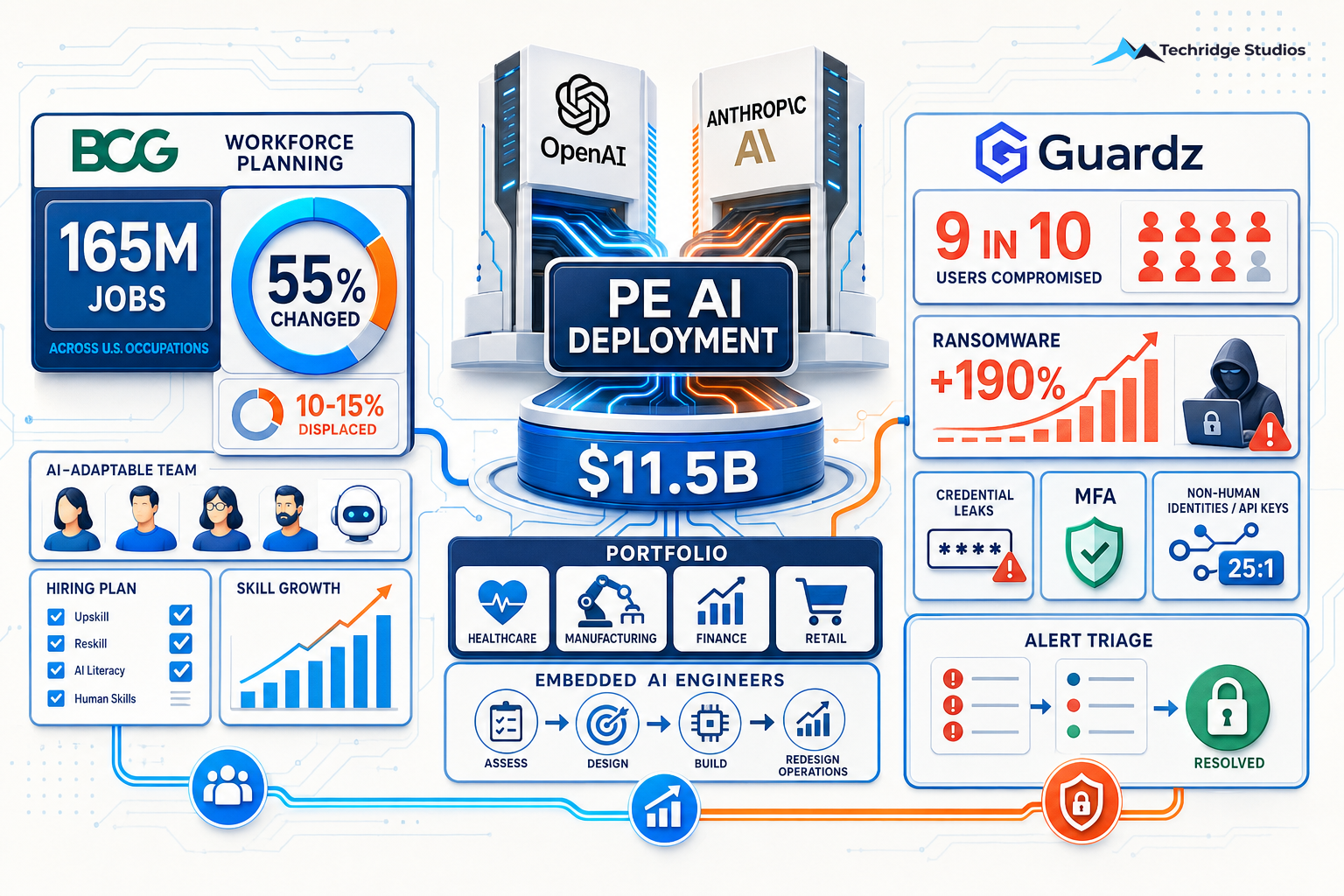
Three stories landed this week that each target a different dimension of running a business in 2026: a major workforce study quantifying exactly how much AI will change every job, two AI labs choosing private equity as their fastest deployment route to market, and a cybersecurity report showing most small businesses are already operating with compromised accounts. Taken together, they describe the current operating condition — not a future one.
BCG: 55 Percent of US Jobs Will Be Substantially Changed by AI Within Three Years
The BCG Henderson Institute published one of the most comprehensive workforce analyses of the AI era: an examination of 165 million US jobs across 1,500 occupations. The headline finding: 50 to 55 percent of US jobs will be substantially changed by AI within the next two to three years. Only 10 to 15 percent of jobs are projected to be fully displaced over a longer time period.
The distinction between "changed" and "eliminated" is the most important thing in this report. BCG's data does not describe a wave of mass layoffs. It describes a fundamental transformation of how work gets done — where the same roles remain but the skills required to fill them shift considerably. Workers who adapt to AI tools and AI-augmented workflows will remain competitive. Workers who do not will face mounting disadvantage without their jobs technically disappearing overnight.
For small business owners, this creates a specific hiring and team management challenge. In a business with 5 to 50 employees, every role matters. If 55 percent of those roles will look substantially different within three years, you cannot afford to hire only for current-state skills. The question to add to every hiring process: how does this person learn new tools, and how quickly did they adapt the last time something changed? AI adaptability is becoming as important as domain expertise.
The practical steps are not complicated: build AI literacy into your onboarding process, identify one or two team members to take the lead on AI tool adoption in each function, and factor AI tool proficiency into performance reviews. The businesses that do this consistently over the next 12 to 18 months will have a meaningful structural advantage in their hiring pools.
OpenAI and Anthropic Just Made Private Equity Their Distribution Channel — and That Matters for Your Business
On May 4, 2026, two of the world's leading AI labs announced, on the same day, that they were betting on private equity as their primary route to scale. OpenAI finalized "The Deployment Company," a 10 billion dollar vehicle anchored by TPG, with 19 total investors including Brookfield Asset Management, Advent, and Bain Capital. The structure guarantees investors 17.5 percent annual returns over five years. Anthropic announced a separate 1.5 billion dollar joint venture with Blackstone, Goldman Sachs, Hellman & Friedman, General Atlantic, Apollo Global Management, GIC, and Sequoia Capital.
The strategic rationale is worth understanding clearly: both companies concluded that the traditional enterprise software sales cycle is too slow to capture the next wave of AI adoption. Twelve-to-eighteen-month procurement processes, custom contracts, and proof-of-concept requirements are friction that PE firms do not have. When a private equity firm decides to deploy AI across its portfolio of operating companies, it issues a directive — not a request for proposal.
Anthropic's joint venture is particularly instructive about where deployment is heading. Rather than acting as a consulting firm or a reseller, the venture will embed engineers directly inside portfolio companies to redesign workflows and integrate AI into core processes. The operating thesis is that having access to a model does not change how a company works. You need someone inside the business translating the capability into the workflow.
For small business owners, the direct impact is one step removed but directionally clear. The companies being targeted now are mid-market firms with 100 to 500 employees, operating under PE ownership in healthcare, logistics, financial services, and professional services. As AI deployment proves itself at that tier — and as costs continue to fall — the same tools and workflows will reach smaller businesses faster. The PE wave is the proof-of-concept that will lower the adoption threshold for smaller businesses in 2027 and beyond.
9 in 10 Small Businesses Already Have a Compromised User — AI Is Making It Worse
Guardz, an AI-powered cybersecurity platform serving managed service providers, released its 2026 State of MSP Threat Report with findings that are difficult to read and impossible to ignore. The core number: 89 percent of monitored small businesses had at least one user with confirmed credential compromise at any given time. Not at risk of compromise. Already compromised. Thirty-one percent of users face password exposure each month.
The threat landscape has shifted in a specific way that makes this worse than it sounds. Non-human identities — software integrations, automation workflows, APIs connecting your tools — now outnumber human users in small business environments at a ratio of 25 to 1. When attackers compromise an account that controls an automation stack, they do not just access one person's inbox. They inherit access to every system that automation touches.
AI-driven attacks are accelerating the damage at every level. Session hijacking incidents surged 23 percent. Ransomware incidents are up 190 percent. Business email compromise losses — the attacks where a criminal impersonates an executive or vendor and requests a wire transfer — now run from 140,000 dollars to 1.5 million dollars per incident, up from roughly 40,000 dollars in early 2025. That increase reflects the impact of AI-generated social engineering: better writing, better targeting, better timing, delivered at scale to thousands of small business targets simultaneously.
The actionable response is not complicated, but it requires taking these numbers seriously. Three steps every small business should take this week: enable multi-factor authentication on every account without exception, audit which integrations and automations have access to your critical systems and revoke anything unnecessary, and ask your IT partner or managed service provider whether a monitoring tool like Guardz is part of your current security stack.
What This Means for Your Business
The three stories from this week tell a connected story. AI is going to change every role in your business within your current planning horizon. The major AI labs are choosing deployment velocity over traditional sales — and mid-market companies are the proving ground that will reach smaller businesses next. And while all of this is happening, attackers using AI tools are finding that most small business accounts are already open to them.
Two priorities for this week: add an AI adaptability question to your next hiring conversation, and verify that every account in your business has multi-factor authentication enabled. Both take under an hour. Both will matter considerably more in 12 months than they do today.
Sources
BCG Henderson Institute — https://www.bcg.com/publications/2026/ai-will-reshape-more-jobs-than-it-replaces
TechCrunch — https://techcrunch.com/2026/05/04/anthropic-and-openai-are-both-launching-joint-ventures-for-enterprise-ai-services/
PRNewswire / Guardz — https://www.prnewswire.com/news-releases/guardz-report-9-out-of-10-smbs-have-compromised-users-as-ai-driven-attacks-reshape-the-msp-threat-landscape-302755600.html